February 03, 2011
Obama's Sputnik Moment Means Cold War with China

Labels: china policy, obama, politics

March 11, 2010
Obama's China Currency Comment

"China moving to a more market-oriented exchange rate will make an essential contribution to that global rebalancing effort."
A move by Beijing to drastically create a more "market-oriented" exchange rate would mean reducing China's dollar holdings in favor of other currencies or gold. Is this ultimately what Washington really wants? It is also hard to argue that the exchange rate of the Yuan is that out of whack for US exporters when China is year after year the fastest growing market for US exports.
Labels: currencies, exports, foreign exhange, forex, goverment procurement, obama, wto, yuan
January 20, 2010
GOOGLE HIJACKS US CHINA POLICY

Last week Google’s chief Legal Officer flamed China’s central government (and by association Chinese people) on the official Google blog with a cryptic ultimatum that it may “shut down Google.cn, and potentially our offices in China” over a hacker attack. But could Google’s knee-jerk reaction become one of the biggest corporate blunders in American history?
Google first tried to enter China the Yahoo! way by buying a Chinese Internet company. But Google went small taking only a 2% stake in Baidu the leading Chinese search engine portal. Google set up its China business in January 2006 choosing the Chinese name “Gu Ge” meaning “harvesting song.” A few months later Google partnered with China Mobile and invested $50 million for a venture to develop mobile services. Not long after that Google sold its stake in Baidu after Baidu went public on NASDAQ and pocketed a nice return of approximately $63 million. Google chose Taiwan born Kai-fu Lee to head up the Beijing office and said it was in it for the long haul, a must for any foreign business in China.
But Google couldn’t bring it. Kai-fu Lee quit Google China last year to head a Beijing venture capital firm to nurture Chinese Internet startups that will compete directly with Google. Four years on Google is no match for Baidu which consistently claims over 60% of the Chinese search market. Google’s share is flat and falling. According to marketing research company comScore Google’s share of the Chinese search market sank to just 14% last November. And search is just one failure of Google in China.
Google’s main focus in China is mobile phones and related services. Investments in Chinese companies such as Xunlei (a video download service) all seemed to fizzle and somehow end up in Baidu or another company’s favor. China Mobile, with more subscribers than any other telecom, now plans to open its own apps store and develop its own services. Google had plans to launch smart phones in China based on its Android operating system. That was cancelled this week.
The loss of what will most likely be the world’s largest market for smart phones and the apps and mobile advertising that come with them means Google’s showdown has serious implications for its future. Sure most Americans think Google is number 1 everywhere in everything but need Google be reminded that at its peak in 2000 Yahoo! shares also cost three digits and its market capitalization of $120 billion was not far off Google’s worth today?
Google dropped its bomb on China in a blog post with links to reports of the overtly anti-China US-China Economic and Security Review Commission. Within hours Secretary of State Hillary Clinton announced she had been “briefed” by Google and helped spin a media cycle in which Google purchased ads in print media and online to imply its business entanglements are a human rights issue.
Fact is Google is embedded in the Obama White House. Google was the number 3 contributor to the Obama campaign. CEO Eric Schmidt (sitting next to Obama in the photo) sits on the President's Council of Science and Technology Advisers. Three other Google executives are in White House positions including Sonal Shah of Google global development and Andrew McLaughlin head of Global Public Policy and Government Affairs for Google who is the White House's Deputy Technology "czar".

On his first official visit to China Obama told a group of Shanghai youths that the USA considered unfettered Internet access a universal human right and tut-tutted over censorship. Last week Secretary Clinton enshrined the view in her lengthy “Internet Freedom” speech. Billed as a major policy initiative the speech mentioned China throughout and contained a direct ultimatum to Beijing to “conduct a thorough review of the cyber intrusions that led Google to make its announcement.” Afterwards Hillary took questions from an audience filled with plants from front groups and organizations affiliated with the NED (National Endowment for Democracy).
The scold on Internet Freedom is odd considering Hillary believed the Internet needed “gatekeepers” back in 1998. And how relevant is Internet Freedom for the world? Fully a quarter of Americans do not even have the Internet in their homes and broadband access in the USA is one of the lowest in the so-called “developed” world. But to Obama’s crowd America equals the Internet and the Internet equals Google.
NO EVIDENCE FOUND
Google was not alone in the hacker attack. Over 30 multinationals were affected by what was apparently called “Operation Aurora.” But there is no evidence the Chinese government was behind it. American Internet security firms Verisign, Adobe, and McAfee pointed fingers and Microsoft admitted that an unrevealed flaw in Internet Explorer was used by the culprits. Google even suspected its own employees. Headlines in the mainstream media declared “Evidence Found for Chinese Attack” (to quote the New York Times’s lead) when a malware sleuth found a circumstantial link but no direct evidence of Chinese involvement. The attack could just as likely have been a psyop from a rival company or government intent on framing Beijing.
Google now says it wants to stay in China and is working behind the scenes with Beijing regulators. And Google’s co-founders will sell enough stock to reduce their control down to 48% indicating the company may yet be run on business pragmatism over emotion. But the message that China attacked Google is sticking and the incident shows clearly who guides China policy in the Obama White House.
(c) copyright, Ben Calmes 2010
(Disclaimer: the author owns shares of Google via a mutual fund)
Labels: foreign relations, human rights, hypocrisy, obama, yahoo
November 16, 2009
Wishful Thinking on China

Labels: communist china, human rights, obama
November 11, 2009
All Eyes On Asia

In Beijing Obama will have his first official state visit with Chinese Communist Party leaders and already in the USA various right wing interests are pushing for Obama to confront the "ChiComs" with their pet issues such as "human rights" and the need to forcibly appreciate the Chinese currency. Word is Obama will pressure Beijing on climate change. Here's an idea: rather than try fruitlessly to get China to accept sweeping agreements to regulate CO2 emissions and accept Western nation mandates about global warming why not agree to explore a program for both the USA and China to reduce reliance on coal for electric power generation?....
Labels: apec, currencies, foreign relations, hu jintao, human rights, obama
October 15, 2009
Obama China Currency Flip Flop

Labels: currencies, foreign relations, forex, geithner, obama, treasury
Trade Talks Before Obama China Visit

Labels: foreign relations, foreign trade, free trade, imports, obama
October 06, 2009
TRADE WAR: Obama Labor Showdown on China Currency
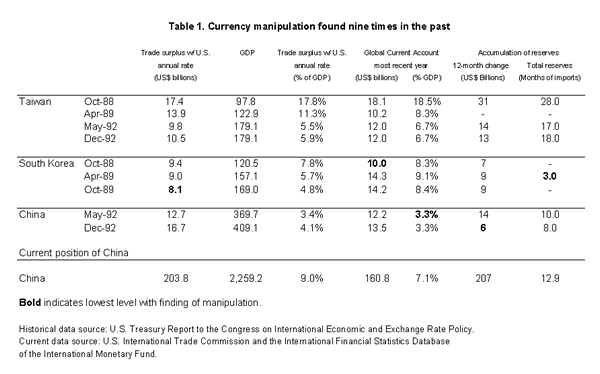
If labor doesn't get their way, which most economists say would be detrimental to both nation's trade and finances, expect a big push for anti-dumping countervailing duties from Congress and the Commerce department. The USA has not accused any nation of manipulating its currency since 1994 when it last leveled that designation on China (see graph at left)....
Labels: currencies, free trade, obama, yuan
September 22, 2009
Greater Chinese Prosperity Zones

Labels: foreign relations, hu jintao, japan, obama, un
September 18, 2009
Obama Hu to Meet at UN

Labels: foreign relations, free trade, hu jintao, obama, un
August 14, 2009
Closing the Gap in US-China Trade

Exports of high-value technology products to China could well become a potentially huge and lucrative new market for an American industry that still has an advantage and help close the gap in the US-China trade deficit....
Labels: foreign trade, obama, technology
July 28, 2009
Obama's China Speech Emphasizes "Partnership"

The word "partner" or "partnership" is mentioned four times in Obama's largely complimentary speech. The speech gives clues to what Obama expects of China: 1) coordination on economic growth and recovery; 2) cooperation on alternative energy to reduce both nations' dependence on oil imports and air pollution; 3) coordination to stop nuclear proliferation, citing Korea and Iran in particular; and 4) cooperation in "confronting transnational threats" (terrorism) with Obama mentioning "increased ties between our militaries."
Overall, Obama's China policy - as defined by his speech - is refreshingly realistic and pays only lip service to ineffectual issues such as "human rights," "currency manipulation," and without one mention of Taiwan, a clear signal that his administration may be the first in over 60 years to not have a "Taiwan Straits Crisis".
Some key points Obama made:
"We can't predict with certainty what the future will bring, but we can be certain about the issues that will define our times. And we also know this: The relationship between the United States and China will shape the 21st century, which makes it as important as any bilateral relationship in the world. That really must underpin our partnership. That is the responsibility that together we bear."
"[T]he United States and China share mutual interests. If we advance those interests through cooperation, our people will benefit and the world will be better off"......
Labels: china policy, obama, strategic dialogue
April 01, 2009
Official USA Statement on Obama-Hu Bilateral Meeting
The two sides agreed to work together to build a positive, cooperative and comprehensive U.S.-China relationship for the 21st century and to maintain and strengthen exchanges at all levels. President Hu Jintao invited President Obama to visit China in the second half of this year, and President Obama accepted the invitation with pleasure.
The two sides decided to establish the "U.S.-China Strategic and Economic Dialogue." U.S. Secretary of State Hillary Clinton and Chinese State Councilor Dai Bingguo will chair the "Strategic Track," and U.S. Secretary of the Treasury Timothy Geithner and Chinese Vice Premier Wang Qishan will chair the "Economic Track" of the Dialogue, each as special representatives of their respective presidents. The two sides will hold the first round of the dialogue in Washington, D.C., this summer. The two sides stated that they will continue to advance mutually beneficial cooperation in economics and trade through the mechanism of the high-level Joint Commission on Commerce and Trade.
The two sides agreed to further deepen mutually beneficial cooperation in a wide range of areas, including economy and trade, counterterrorism, law enforcement, science and technology, education, culture and health. They also agreed to resume and expand consultations on non-proliferation and other international security topics. They welcomed further exchanges between the national legislatures, local authorities, academics, young people and other sectors. The two sides agreed to resume the human rights dialogue as soon as possible.
Labels: foreign relations, hu jintao, obama, strategic dialogue
Atlantic Alliance vs. G3

The most important meetings at the G20 summit in London will be done by the end of the day: the first official face-to-face between President Obama and Russian President Medvedev and Chinese President Hu Jintao and the private meeting between Obama and Queen Elizabeth II.
Much discussion centers over whether a new G2 is emerging between the USA and China, the forces behind the world's number 1 and 2 "new deals" of government spending. But just as important is the potential that the USA and Russia may reduce their nuclear stockpiles perhaps someday down to a mere 1,000 armed missiles apiece. While China's nuclear capacity is a deterrant (to invasion and/or attack) only such a development would in effect create a tripolar world between USA, Russia, and China.
The one bit of substance from Obama and Hu meeting is the tweaking of the US-China Strategic Economic Dialogue - the word "and" is now added between Strategic and Economic enlarging the focus to matters of State (Sec. State Clinton) and Treasury (Sec. Geithner).
An aside: the hapless crowd of protesters outside the Bank of England with all their competing slogans, costumes, and aims recalls Chairman Mao's observation before the Paris Riots in the 60's that there will be no capitalist crisis great enough in the future to bring the middle classes into the streets for a 20% rise in wages as the bourgeoisie had co-opted itself to the ruling class. Were this really the "greatest financial crisis since the Great Depression" or the true Crisis of Capitalism predicted by Marx the protesters in London would not leave the streets. Odds are they will all be back in their flats by nightfall...January 30, 2009
OBAMA PHONES HU, FIRST MEETING SET

Labels: foreign relations, hu jintao, obama
December 02, 2008
Remember it was Bill Richardson who Exposed Wen Ho Lee

Obama has named Bill Richardson to be his Secretary of Commerce in the new administration beginning 2009. Lest we forget, it was Bill Richardson who led the shameful anti-Chinese witch hunt against Dr. Wen Ho Lee and fed the American media disinformation about Lee and by so doing undermined his President's own standing with his conservative adversaries and the American people. Richardson is a buffoon who infamously said during his brief run for the Presidency that he believed being gay was a choice. Obama is rewarding Richardson with a position in his cabinet as payback for Richardson's quick endorsement and to pander to latino support of his government.
Looking back on the Wen Ho Lee moment:
The Case of Wen Ho Lee ("Charged With Being Ethnic Chinese," Pacific News Service, 2000)
Watch NORichardson's recap of 60 Minutes Wen Ho Lee expose.
Sign a petition to tell Congress to say NO to Richardson's confirmation.
Labels: obama, propaganda
November 01, 2008
Obama: China Manipulates Currency

Just days away from the Presidential election, Obama told a group of Textile industry lobbyists that he would take "all diplomatic means" to induce China to make a series of recommended changes to the satisfaction of America's textile mill owners.
Further, he embraced mandating the "Buy America" provision in Defense related procurement. Taking this stand, however, will give China no incentive to accede to the WTO Government Procurement Agreement, long over due after seven years of WTO membership privileges. It is a form of protectionism wrapped in the flag to appear patriotic. It is a dangerous sign that an Obama administration -- like all others before it -- may open to lobbying influence in China policy.
Labels: china policy, chinese trade, free trade, lobbyists, obama

Subscribe to Posts [Atom]
