September 15, 2010
CURRENCY MANIPULATORS

Twenty-five years ago the USA forced Japan to appreciate its currency in order to correct its own bad books by fixing (temporarily) America's current account deficit. The Plaza Accord of 1985 led to rampant speculation in the Yen and a financial crisis and depression from which the Japanese have yet to recover. From the sidelines, having secured the return of Hong Kong and its capital, Beijing watched and learned.
Since the dotcom bubble popped and jobless recoveries, booms, and busts have America stalled, certain political factions believe that if Uncle Sam can force a similar appreciation of the Yuan on Beijing the American Dream can be saved. Chief among the politicians is Chuck Schumer (D-NY) and his chorus of taxpayer funded think tank reports and leading talking heads. One of the biggest proponents of the China tariff clique is Nobel Prize winning economist Paul Krugman.
Krugman used his NY Times column again today to call for tariffs on Chinese goods deciding that one lesson from the Great Depression - the Smoot-Hawley Act - is not worth heeding.
I've written many posts and Sinomania! Show episodes on the futility of trying to force Beijing's hand on Yuan. Do a search here and on the Sinomania! website and you'll come up with the same conclusion. America cannot fix its problems by manipulating international forex markets. Beijing unlike Japan is not America's satellite and cannot be told what to do and is not afraid of Washington. And the biggest reason why people like Krugman and Schumer know that the issue is just hot air is not the "threat" of a "nuke option" - Beijing selling its holdings of US Treasury securities - but because the average American mired in a deep recession can't afford to pay two and three times for all the stuff they buy from WalMart, Target, IKEA, and everywhere else!
Labels: currencies, financial crisis, forex, free trade, japan, schumer, yuan
# posted by Sinomania! : 9/15/2010 02:23:00 PM
1 Comments

March 15, 2010
Krugman's Last Stand

Columnist
Paul Krugman of the New York Times says the US government needs to "take a stand" against China by declaring that Beijing "manipulates" its currency (Renminbi) and slap big extra tariffs on Chinese imports. Krugman began the year with the same message and seems willing to stake his reputation on his quixotic quest. Frankly the US has already taken a stand on the issue of the Yuan/Dollar exchange rate and been stood down. Further Krugman's simplistic explanation of alleged Chinese "mercantilism" is surprising from a Nobel Prize winning economist. To blame global economic imbalance on imports of Chinese goods is absurd.
To declare China a currency manipulator while ignoring Tokyo's support of the Yen and other currencies pegged to the US dollar including oil exporting nations and whole regions (the Caribbean, etc.) is a selective and hostile act. And if the Yuan is so undervalued why are the EU, Brazil, Australia, and other countries with important China trade not joining the USA in a stand against China?
Millions of Americans are already cutting back on what they buy and trying to make do with less. Do we need the cost of everything to go up because of additional tariffs on Chinese goods? Does Krugman think stagflation will help the American economy recover?
Labels: anti-china, currencies, forex, free trade, renminbi, yuan
# posted by Sinomania! : 3/15/2010 11:52:00 AM
0 Comments
March 11, 2010
Obama's China Currency Comment

Headline writers this afternoon say President Obama "urged" China to stop controlling its currency. What did Obama say exactly? Long into a
banal booster speech at the annual meeting of the Export-Import Bank of the United States (a federal government agency), Obama said
"China moving to a more market-oriented exchange rate will make an essential contribution to that global rebalancing effort."
It surprises me Obama continues to spend political capital in a pointless pursuit to coerce Beijing to appreciate its currency. Washington can urge China all it wants but Beijing has made its position on Renminbi very clear. Just this week at the National People's Congress session China said the Yuan's unofficial peg to the US dollar will end and appreciation up to 10% over the short to medium term is expected.
A move by Beijing to drastically create a more "market-oriented" exchange rate would mean reducing China's dollar holdings in favor of other currencies or gold. Is this ultimately what Washington really wants? It is also hard to argue that the exchange rate of the Yuan is that out of whack for US exporters when China is year after year the fastest growing market for US exports.
A far better use of rhetoric and effort would be for Obama to push Beijing to fulfill its promise to enter into the WTO Government Procurement Agreement (GPA) and open up potentially billion$ in opportunities to American businesses. So far no moves on the GPA have been made by US Trade Rep Ron Kirk or anyone else in the Obama administration. Why not?....
Labels: currencies, exports, foreign exhange, forex, goverment procurement, obama, wto, yuan
# posted by Sinomania! : 3/11/2010 01:35:00 PM
1 Comments
March 10, 2010
China Moves the World

It is an interesting irony that the same mainstream media that criticizes Chinese government data as untrustworthy claims that same data is capable of moving commodities, currency, and stock prices the world over. Consider today's headlines. Chinese numbers on exports and inflation are responsible we read for stock markets going up in the
USA,
Canada, and
Brazil; affected the
Mexican Peso, the (US)
Dollar, and the
Yen; and impacted
gold and
oil markets!....
Labels: exports, forex, gold, inflation, oil
# posted by Sinomania! : 3/10/2010 03:12:00 PM
0 Comments
February 09, 2010
China's Portfolio: AAPL BLK KO NWSA RIMM TCK V

The
China Investment Corporation, the sovereign wealth fund of the Chinese central government, revealed its holdings in a Form 13F filing with the US Securities & Exchange Commission last Friday. The biggest single investment is 101 million+ class B shares of
Teck Resources Ltd., a Vancouver based mining conglomerate listed on NYSE as TCK.
CIC's Major holdings of Morgan Stanley (MS) and Blackrock (BLK) are well known but less known are sizeable share blocks in
healthcare and pharmaceuticals including Health Net, Abbott Labs, Pfizer, Merck, Eli Lilly, and
financials & banks such as Metlife, Bank of America, Citigroup, Comerica, and Wells Fargo.
China owns 30,000 shares of
Apple; 158,100 shares of
Coca-Cola; 300,000 shares of Rupert Murdoch's
News Corp.; 401,100 shares of
Sprint; and $350 million worth of
Visa, Inc. China also has investments in
iShares indexes and
SPDR ETFs ranging from $50 million+ to over $200 million per account. The Form 13F and full list of China's portfolio can be viewed at the Sinomania! website
here.
Chart via CFR.org, Brad Setser....
Labels: foreign investment, foreign relations, forex, stocks
# posted by Sinomania! : 2/09/2010 02:14:00 PM
0 Comments
November 30, 2009
No Word on Yuan at EU-China Summit

The EU is now China's number 1 trading partner. For the EU China is now number 2 after the USA. EU imports from China are down in the great recession to just over $65 billion euros in the 1st Half of 2009. Overall China accounts for 17% of all EU imports. As in the USA China is a growing market for exports accounting for 7% of EU exports, up one percent from 2008. The top EU exporters to China are Germany, France, Italy, UK, and Netherlands - in that order. While the EU overall has a trade deficit with China, the smallest individual deficits are in Germany and France which have the healthiest trade relations with China.
Click here for more detail on EU-China trade....
Labels: currencies, euro, foreign relations, foreign trade, forex, yuan
# posted by Sinomania! : 11/30/2009 09:55:00 AM
0 Comments
October 15, 2009
Obama China Currency Flip Flop

Today the US Dept. of the Treasury released its semiannual
Report to Congress on International and Exchange Rate Policies with the decision that China does not "manipulate" its currency. With somewhat contorted logic Treasury says that since the renminbi remains stable against the dollar it follows the movement of the dollar against other currencies although it is still "undervalued." The report revealed that China is anticipated to account for 2/3 of global growth in 2010. The reaction of Congress awaits....
Labels: currencies, foreign relations, forex, geithner, obama, treasury
# posted by Sinomania! : 10/15/2009 03:35:00 PM
0 Comments
September 16, 2009
China US Treasuries Over $800 Billion

Labels: dollar, forex, treasury
# posted by Sinomania! : 9/16/2009 09:58:00 AM
2 Comments
September 03, 2009
Beijing Converts 50 Billion $ to SDR [CORRECTION]
[CORRECTION:
Reuters reports that the People's Bank of China will use Yuan not dollars to buy the IMF SDRs.]
Labels: dollar, financial news, forex, gold
# posted by Sinomania! : 9/03/2009 11:43:00 AM
0 Comments
September 01, 2009
Thailand, Russia Explore Yuan Currency Swap

Labels: currencies, foreign trade, forex, yuan
# posted by Sinomania! : 9/01/2009 10:09:00 AM
0 Comments
June 30, 2009
Hong Kong-China Trade Settlement in Yuan by July

Labels: chinese trade, currencies, forex, renminbi, yuan
# posted by Sinomania! : 6/30/2009 11:52:00 AM
0 Comments
April 24, 2009
CHINA INCREASES GOLD RESERVES

After weeks of speculation, it's official:
China gold reserves increased and China now holds more gold than Switzerland. The US, Germany, France, and Italy still hold far more gold but the acknowledgement by the head of the aptly named SAFE (State Administration of Foreign Exchange) lead many to believe that Beijing may soon buy gold. The last reported figure for China's gold reserves was in December 2002 at approximately 600 tons. The new figure is 1,054 tons of gold and Beijing says the increase came from domestic sources. China is the leading gold producer in the world and could easily increase its gold reserves from its own mines. The planned sale of IMF gold however could proved tempting.
Labels: currencies, forex, gold
# posted by Sinomania! : 4/24/2009 02:19:00 PM
0 Comments
April 16, 2009
Is China Hoarding Copper?

Lots of
speculation in the news about moves by the State Reserve Bureau in Beijing to buy huge amounts of primary metals, particularly copper but also aluminum and cobalt. Is China planning a copper standard to back the Yuan? Is Beijing stockpiling industrial resources while the global economy is down in order to be ready for the next boom cycle? Or is China really still chugging along at full speed (compared to sluggish Western economies) despite the impact of the Panic of '08?....
Labels: currencies, foreign exchange, forex, renminbi, yuan
# posted by Sinomania! : 4/16/2009 04:10:00 PM
0 Comments
April 14, 2009
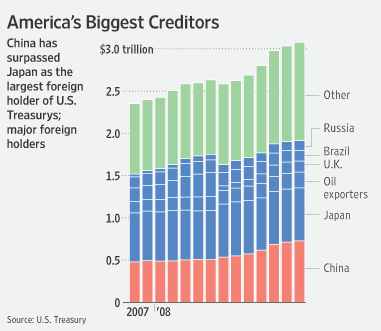
China Forex Reserves Near $2 Trillion
Labels: forex, gold
# posted by Sinomania! : 4/14/2009 09:57:00 AM
0 Comments
February 15, 2008
Japan Forex Reserves Growing "Suspiciously Fast"

"Japan’s reserves are growing suspiciously fast. Japan’s foreign reserves expanded from US$946 billion in September 2007 to US$996 billion in November, an increase of US$50 billion in four months. Assuming a 2.5-3.0% return on the underlying assets, Japan should only be enjoying US$25-30 billion in annual investment earnings, or US$6-8 billion a quarter. Further, it is widely assumed that Japan has the bulk (90%) of its reserves in USD, and the MoF never diversified away from USD. With such low holdings of EUR, valuation changes – from the rise in EUR/USD – should not have been a major factor generating gains in reserves. Indeed, what is embedded in our reserve tracker file assumes 90% USD holdings. Our presumptive calculations identified a US$13.7 billion gain during September-January due to the returns on the underlying assets, and another US$18 billion from valuation changes, leaving US$18 billion of the reserve increases unexplained by our metric. Could the MoF have conducted secretive interventions worth US$18 billion? "
Morgan Stanley believes the net result is not stealthy intervention but skillful day trading of Yen/Euro positions and that the data reveals Japan is diversifying away from the US Dollar to over 20% Euro composition in its foreign exchange reserves.
If true, this raises another interesting question: Is America's loyal Asian satellite dumping the Dollar?
Labels: currencies, euro, foreign exchange, forex, globalization, japan
# posted by Sinomania! : 2/15/2008 02:03:00 PM
0 Comments

Subscribe to Posts [Atom]
