July 28, 2009
Obama's China Speech Emphasizes "Partnership"

The first Obama Administration China summit concludes today. The "Strategic and Economic Dialogue" takes USA-China relations a step further away from "strategic competitor" under W and back to the late Bill Clinton era (post 1996) view of China as a "partner."
The word "partner" or "partnership" is mentioned four times in Obama's largely complimentary speech. The speech gives clues to what Obama expects of China: 1) coordination on economic growth and recovery; 2) cooperation on alternative energy to reduce both nations' dependence on oil imports and air pollution; 3) coordination to stop nuclear proliferation, citing Korea and Iran in particular; and 4) cooperation in "confronting transnational threats" (terrorism) with Obama mentioning "increased ties between our militaries."
Overall, Obama's China policy - as defined by his speech - is refreshingly realistic and pays only lip service to ineffectual issues such as "human rights," "currency manipulation," and without one mention of Taiwan, a clear signal that his administration may be the first in over 60 years to not have a "Taiwan Straits Crisis".
Some key points Obama made:
"We can't predict with certainty what the future will bring, but we can be certain about the issues that will define our times. And we also know this: The relationship between the United States and China will shape the 21st century, which makes it as important as any bilateral relationship in the world. That really must underpin our partnership. That is the responsibility that together we bear."
"[T]he United States and China share mutual interests. If we advance those interests through cooperation, our people will benefit and the world will be better off"......
Labels: china policy, obama, strategic dialogue

July 14, 2009
1st USA-China "Strategic & Economic Dialogue" Set for July 27-28

The new fangled US-China Strategic AND Economic Dialogue, the Obama administration's twist on the W and Hu founded Strategic Economic Dialogue, will meet July 27 and 28 in Washington, DC, and include a joint press conference on its final day. The group will include Treasury Secretary Geithner and Secretary of State Hillary Clinton for Washington and Dai Bingguo and Wang Qishan for Beijing....
Labels: foreign relations, strategic dialogue
April 01, 2009
Official USA Statement on Obama-Hu Bilateral Meeting
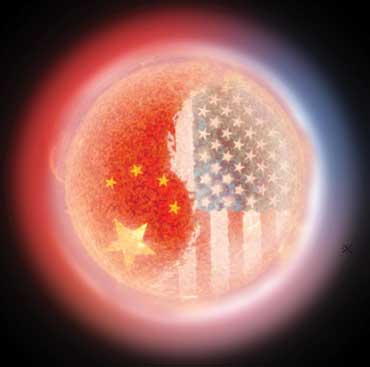
In its entirety for posterity:
Statement On Bilateral Meeting With President Hu Of China
Office of the Press Secretary, 04.01.09, 10:47 AM EDT
Hu and Obama discuss U.S.-China relations.
On April 1, 2009, President Barack Obama of the U.S. and President Hu Jintao of China met on the sidelines of the G-20 Financial Summit in London. The two heads of state had an extensive exchange of views on U.S.-China relations and global issues of common interest, and reached the following points of agreement:
I. Toward Enhanced U.S.-China Relations
The two sides agreed to work together to build a positive, cooperative and comprehensive U.S.-China relationship for the 21st century and to maintain and strengthen exchanges at all levels. President Hu Jintao invited President Obama to visit China in the second half of this year, and President Obama accepted the invitation with pleasure.
The two sides decided to establish the "U.S.-China Strategic and Economic Dialogue." U.S. Secretary of State Hillary Clinton and Chinese State Councilor Dai Bingguo will chair the "Strategic Track," and U.S. Secretary of the Treasury Timothy Geithner and Chinese Vice Premier Wang Qishan will chair the "Economic Track" of the Dialogue, each as special representatives of their respective presidents. The two sides will hold the first round of the dialogue in Washington, D.C., this summer. The two sides stated that they will continue to advance mutually beneficial cooperation in economics and trade through the mechanism of the high-level Joint Commission on Commerce and Trade.
The two sides agreed to further deepen mutually beneficial cooperation in a wide range of areas, including economy and trade, counterterrorism, law enforcement, science and technology, education, culture and health. They also agreed to resume and expand consultations on non-proliferation and other international security topics. They welcomed further exchanges between the national legislatures, local authorities, academics, young people and other sectors. The two sides agreed to resume the human rights dialogue as soon as possible.
Both sides share a commitment to military-to-military relations and will work for their continued improvement and development. The two sides agreed that Admiral Gary Roughead, U.S Chief of Naval Operations, will visit China upon invitation in April to attend events marking the 60th anniversary of the founding of the Navy of the Chinese People's Liberation Army. The U.S. looks forward to visits by senior Chinese military leaders this year.
The two sides agreed to maintain close communication and coordination and to work together for the settlement of conflicts and reduction of tensions that contribute to global and regional instability, including the denuclearization of the Korean Peninsula, the Iranian nuclear issue, Sudan humanitarian issues and the situation in South Asia.
The two sides agreed to intensify policy dialogue and practical cooperation in energy, the environment and climate change building on the China-U.S. Ten Year Energy and Environment Cooperation Framework, carry out active cooperation in energy efficiency, renewable energy, and clean energy technologies and work with other parties concerned for positive results at the Copenhagen conference.
II. Strengthening Economic and Financial Cooperation
The two presidents discussed challenges facing the global economy and financial system. They pledged that, as two major economies, the U.S. and China will work together, as well as with other countries, to help the world economy return to strong growth and to strengthen the international financial system so a crisis of this magnitude never happens again.
The two presidents welcomed the fiscal stimulus measures taken by the other, and agreed that these measures were already playing a stabilizing role for the global economy. They also agreed that strong financial systems were essential for restoring growth, and they welcomed the commitment of both countries to address issues in this area. President Obama underlined the commitment of the United States to implement the American Recovery and Reinvestment Act and the Financial Stability Plan. He underscored that once recovery is firmly established, the United States will act to cut the U.S. fiscal deficit in half and bring the deficit down to a level that is sustainable. President Hu emphasized China's commitment to strengthen and improve macroeconomic control and expand domestic demand, particularly consumer demand, to ensure sustainable growth, and ensure steady and relatively fast economic development.
The two presidents agreed the international financial institutions should have more resources to help emerging market and developing nations withstand the shortfall in capital, and the two countries will take actions toward this goal. China and the United States agreed to work together to resolutely support global trade and investment flows that benefit all. To that end, they are committed to resist protectionism and ensure sound and stable U.S.-China trade relations.
President Hu and President Obama discussed regulatory and supervisory changes needed to reform and strengthen the global financial system, including regulatory standards. President Hu welcomed the recent U.S. announcement of a comprehensive financial regulatory reform agenda. President Obama welcomed the commitment of China to continue the development and reform of its financial system.
The Presidents agreed on the need for sweeping changes in the governance structure of international financial institutions.
President Obama underscored that such changes were needed so that these organizations better reflect the growing weight of dynamic emerging market economies in the global system.
President Hu and President Obama concluded that continued close cooperation between the United States and China was critical at this time to maintain the health of the world economy and would remain so in the future. They both recognized that as major economies, the United States and China have a need to work together, as well as with other countries, to promote the smooth functioning of the international financial system and the steady growth of the world economy.
To this end, the two sides will exchange views and intensify coordination and cooperation on global economic and financial issues, climate change and energy, and other important issues through the Strategic and Economic Dialogue that the two countries have decided to establish.
Labels: foreign relations, hu jintao, obama, strategic dialogue
February 13, 2009
Clinton Signals China Policy Back at State Department

USA Secretary of State Hillary Clinton will make her first state visit to East Asia starting Sunday. She will visit the "allied democracies" (satellites) Japan and South Korea, Indonesia, and China (not in that order). Clinton has already made it clear that in the Obama administration China policy will be a "comprehensive dialogue" believed by some to be a stab at the George Bush and Hu Jintao founded Strategic Economic Dialogue. Indications are the SED will continue as an important series of meetings but not dominate US-China relations. Various competiting interests want to guide Clinton in her China focus. The prestigious Asia Society wants climate change to be the focus. Taxpayer funded "human rights" groups want to press Beijing's feet to the fire on "democracy" and Tibet.
But Clinton's remarks at the Asia Society gathering today in Manhattan indicate that she and her boss President Obama are starting off with a pragmatic and positive note on China. Earlier today Clinton said: "Now, some believe that China on the rise is, by definition, an adversary. To the contrary, we believe that the United States and China can benefit from and contribute to each other’s successes," adding:
"Even with our differences, the United States will remain committed to pursuing a positive relationship with China, one that we believe is essential to America’s future peace, progress, and prosperity. "
Labels: foreign relations, strategic dialogue
December 05, 2008
Paulson In Beijing: US-China Relations "Vital"

BEIJING - In closing remarks today at the 5th session of the US-China Strategic Economic Dialogue, out-going Treasury Secretary Paulson said "the U.S. – China economic relationship will continue to be vital to the health of our two economies and the global economy" and generally praised the cooperative efforts to date between the USA and China to stabilize the global economy in the midst of the Panic of '08.
Several measures were unveiled including a $20 billion committment for each nation's export/import banks to extend credit to worthy importers.
The Strategic Economic Dialogue was started by Presidents Bush and Jiang. It has already lasted through China's presidential transition. Will it survive under President Obama?
Labels: exports, financial crisis, panic of 2008, paulson, strategic dialogue
July 21, 2008
Learn From Subprime Says Paulson

Meeting with BusinessWeek magazine editors US Treasury Secretary Paulson told of a recent exchange with his Beijing buddies:
Vice-Premier Wang Qishan (his Chinese counterpart in the US-China Strategic Economic Dialogue) said to Paulson recently, “We’ve been listening a lot to you and now we find out our teacher has problems.” Paulson said he responded, “Learn from us and you can avoid some of the mistakes.”
Teacher has problems, indeed.
hat tip to John M at Calculated Risk blog
Labels: credit crunch, financial crisis, paulson, sed, strategic dialogue, subprime
June 17, 2008
Paulson: China and USA to Maintain "Global Economic System"

The 4th Strategic Economic Dialogue bilateral talks between China and the United States are underway in Annapolis, Maryland.
The Chinese delegation is emphasizing joint cooperation on energy and the environment stressing that the world's number 1 and 2 oil importers have much to gain by working together.
Treasury Secretary Hank Paulson said that both nations are responsible for "maintaining a stable, secure and prosperous global economic system."
It is only a matter of time before China becomes an issue in the Presidential elections. Will the strategic dialogue fall victim to politics by year's end?
Labels: china, chinese trade, paulson, strategic dialogue, treasury

Subscribe to Posts [Atom]
