September 09, 2010
What Happened to the China Collapse Call?

Stephen Green of Standard Chartered Bank (Shanghai), an expert in China's stock markets, writes in Bloomberg that China is returning to a "Sweet Spot" for foreign investment as the Chinese economy is neither too hot nor too cold. China may see an influx of $100 billion (US dollars) in FDI this year.
Morgan Stanley's Chief Economist for China Qing Wang (he replaced Andy Xie) calls it the "Goldilocks Scenario" and has advised for some time that Beijing's mandarins are skilled at using the right policy tools at the right time and have succeeded so far in avoiding hyperinflation and any crash including it appears a property bubble.
If China is Goldilocks what about the Bears that said China was too hot/cold and ready to crash? Mark Faber, Jim Chanos, and others may have some explaining to do if China doesn't disintegrate soon...
Labels: chinese stocks, economy, financial news, morgan stanley

August 16, 2010
CHINA MAY ALREADY BE WORLD'S LARGEST ECONOMY
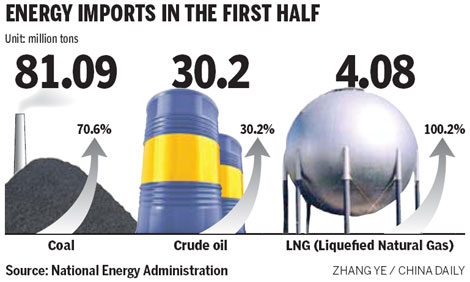
As regular readers know I believe a nation's energy use and production a much better gauge of an economy's size than Gross Domestic Product which is easily manipulated by central governments (Washington is as guilty as Beijing in that regard) and made meaningless by currency exchange. On a purchase power parity basis China has been the second largest economy for a very long time.
Earlier this summer China surpassed the USA as the world's number one energy user according to the International Energy Agency (Beijing rejects the designation). To me this says that China is already the largest economy in the world. That is a change of historic significance. Around a century ago the USA took that top energy spot and kept the position until now...
Labels: economy, energy security, gdp, global economy
March 05, 2010
China's Parliament Convenes
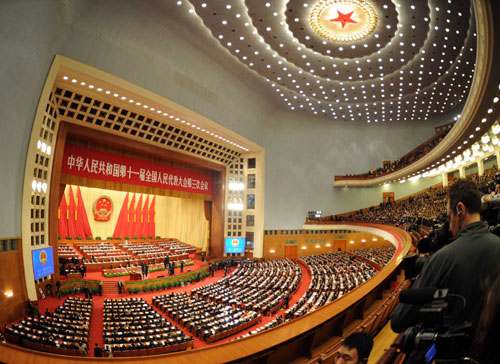
The annual session of the Chinese unicameral legislature opened in the Great Hall of the People today in Beijing. It is the third session of the 11th National People's Congress (NPC) and will run to around March 15. Many observers, particularly American mainstream media, dismiss the NPC session as a carefully controlled rubber stamp farce. But reporters expecting surprises don't understand the institution or the process. The NPC is one of the world's largest representative bodies. And yes it is representative. Approximately 3,000 delegates are selected by the Chinese Communist Party by an elaborate method and in some instances by direct election down to the village level. Some of the elections are internationally recognized as fair and competitive. The NPC affirms the direction China is going and gives law to Beijing’s policies.
Prime Minister Wen Jiabao opened with a report on the economy and presentation of the central government budget. As in many nations today the Chinese government is predicting a deficit (around $154 billion). And while overall government spending is increasing the rate from last year is decreasing. Unreported in world media is a drop in Chinese defense spending the number 1 item in the government budget just as in the USA.
Wen said Beijing will loosen the grip of state power on "monopoly industries" and encourage further corporatization of state-owned enterprises. This is a signal that more government owned shares may be sold into market and that further privatization will occur....
Labels: economy, government, national peoples congress
February 18, 2010
China Doomsayers

None other than famous "Dr. Doom" Marc Faber has joined the chorus calling for a China crash this year. Marc Faber is well known for warning clients about the 1987 Wall Street selloff but he has been right about as often as a flashing clock since then although Faber's views on long trends are very prescient. If you had followed Faber's advice in January 2007 (see The Sinomania! Show episode 3) you would have missed out on the spectacular run up in Chinese stocks that saw the Shanghai Composite Index balloon to over 6,124. And Faber was wrong in 2003 when he said that SARS would ruin the Chinese economy. Most analysts believe and data appears to support continued strong growth in China with the risk to overheating versus a profound slowdown. Time will tell....
Labels: chinese stocks, economy, global economy, markets, stock market
January 27, 2010
China Year End 2009 Data Shows Strong Stable Growth
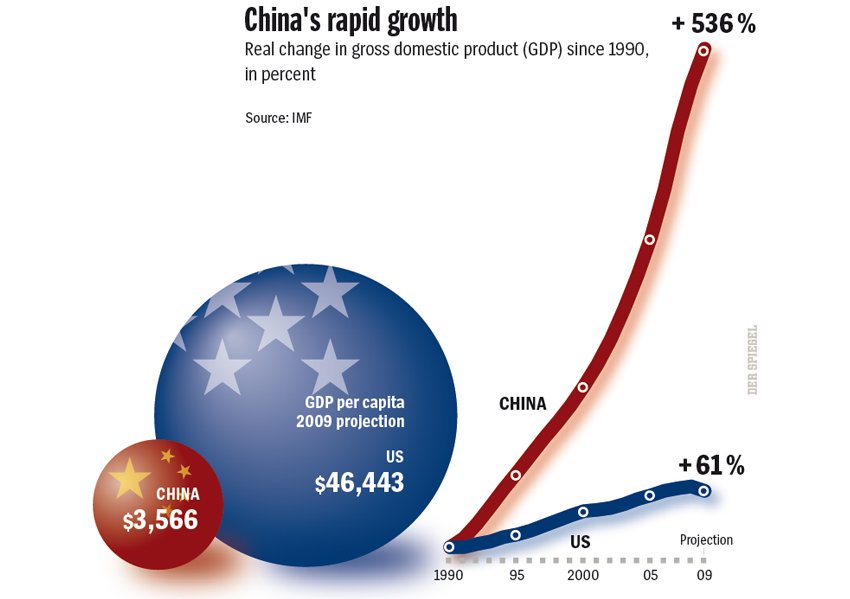
Remember how 2009 began (much like this new year) with predictions of a crash in China because Beijing had poor experience handling a recession and China couldn't possibly decouple from the global recession? Turns out the Chinese economy grew steadily and healthfully all 2009. Here are data points for last year: GDP expanded 8.7%; retail sales grew (in real terms) 16.9%, better than 2008; fixed asset investment grew 30.1% with urban fixed asset investment at 30.5%; capital expenditure investment in secondary & manufacturing industry expanded 26.8%; RMB 9.59 trillion (Yuan) in loans were issued, a 95% increase; exports were down -16% to $1.2 trillion (US dollars) and imports dropped -11.2% to $1 trillion; with exports down Chinese industrial output grew only 11%, the slowest since the 2001 recession; Beijing's foreign exchange reserves grew to $2.4 trillion; although food prices remain inflationary, overall CPI deflated to 0.7%....
Labels: economy, exports, foreign exchange, inflation, investment
August 26, 2009
Beijing Pops Bubbles

Concerned about overcapacity and overinvestment in certain sectors, Beijing has put the following industries on notice: steel, cement, plate glass, coal chemical, poly silicon (the key component in solar panels), and wind power. All will be "guided" by relevant government departments in the following areas: market access (share issues & loans), land use (access and sales), and environmental supervision (pollution control). Lately, overcapacity in the solar sector has been an issue globally with excess supply bringing down prices. Look for greater consolidation in these industries and with luck the grooming of major potential Chinese multinational corporations.....
Labels: clean tech, economy, investment, steel
April 16, 2009
China to Promote Hemp Cultivation
The green light has been given to establish hemp cultivation areas in Yunnan, Heilongjiang, Gansu and Anhui provinces as well as the autonomous regions of Xinjiang and Inner Mongolia with the goal of creating a new resource for textiles and paper and bringing millions out of poverty by 2020. Already production is begun in remote district of Yunnan province.
Hemp originated in China. Archeological evidence dating back 9,000 years shows it was a cultivated plant. The psychoactive component THC appears to have occured through experimentation with the plant sometime around 3,000 years ago when varieties yielding marijuana were achieved. Although classified a controlled substance by Beijing, as visitors to China know, marijuana use is widespread and not agressively criminalized as in the USA.
But the hemp cultivation envisioned in the new programs is not marijuana but a Chinese hemp variety called Yunma I and Yunma II developed over the past 20 years to yield even stronger fibers but very low THC content....
Labels: clean tech, economy, land reform
April 10, 2009
China Slowdown Slows Down

The pace of decline in some leading economic indicators for China such as trade balance is lessening leading some forecasters to believe the bottom may have been reached in the Chinese economy. While exports to all major Chinese markets continued to drop in the 1st Quarter the USA remains the strongest market with a decline of -14.9% versus over -16% for Japan and over -22% for the EU, China's number 1 market.
Some other indicators for China: March 2009 trade balance: Exports $90.3 billion; Imports $71.7 billion; surplus $18.6 billion / Export growth -17.1%; Import growth -25.1% // Jan-Feb 2009 Industrial Output: 3.8% // Jan-Feb 2009 Retail Sales growth: 15.2% // February 2009 Producer Price Index: -4.5% // February 2009 FDI inflows: $5.8 billion...
Labels: economy, foreign trade
April 03, 2009
Chinese Manufacturing Up in March

The China Purchasing Managers' Index, a gauge of nationwide manufacturing activity, stood at 52.4 in March, up from 49.0 in February, and well above its lows of 38.8 in November.
The March data mark the first time the indicator has been above 50 since September, a threshold that indicates activity in the manufacturing sector is in an expansionary mode. Source: MarketWatch...
Labels: economy, panic of 2008
March 11, 2009
Deflation: Negative CPI First Since 2002 in China
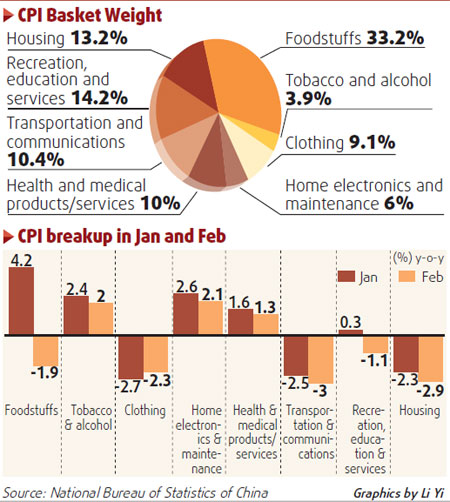
Consumer prices are falling in China with overall CPI down -1.6% the first negative inflation indication since 2002...
January 22, 2009
China Q4 2008 End Year Macro Data
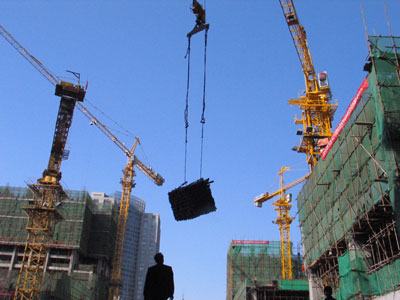
Released today... Retail sales for the year reached $1.59 trillion (US dollars) showing Chinese have a long way to go to supplant the American consumer. State investment topped $2.5 trillion value and will likely increase with Beijing stimulus plans...
Labels: economy
November 13, 2008
Details on China Stimulus Infrastructure Projects

The State Council in Beijing released some details on multi-billion dollar value infrastructure projects included in the big stimulus package:
Gas pipeline from western China to Guangzhou and Hong Kong (perhaps to meet up with pipelines currently under construction from Kazakhstan and Turkmenistan);
Nuclear power plants in Zhejiang and Guangdong Provinces (mostly likely Westinghouse AP-1000 type);
Airports in Inner Mongolia (a rising wind power area) and Anhui Provinces;
and water conservation projects in Xinjiang, Guizhou, and Jiangxi.
Labels: economy, panic of 2008
October 29, 2008
Shenzhen Picked for UPS Intra-Asia Hub

UPS broke ground today on a huge new shipment and processing hub in Shenzhen, China, that will replace its current intra-Asia hub at the former Clark (USA) Air Force Base in the Philippines. The facility will employ 400 people at opening and its capacity can be expanded to three times its size. This is what economic slowdown looks like in China...
Labels: china, economy, foreign trade
July 09, 2008
China Number 1 by 2035: REPORT

According to the prestigious and often highly influential Carnegie Endowment for International Peace, the Chinese economy will surpass the USA by 2035 and possibly be double in size by mid century, far outpacing any other nation. The report challenges the notion that China's development is centered on exports to the United States and other "developed" nations.
Labels: china, devlopment, economy, exports, gdp, gnp, number 1, usa
May 22, 2008
Sichuan Earthquake Economic Toll at 0.5% GDP

Damage from the Sichuan earthquake is estimated at close to $10 billion (US) and shares of companies in the region effected by the quakes fell on Chinese stockmarkets and caused a broader decline in Chinese stocks. The Shanghai Composite Index is back down below 3,500 and the CSI 300 Index also plunged this week on the bad news about the impact of the massive earthquake just ten days ago.
Beijing now says over 50,000 people perished in the disaster and expect the death toll to continue to climb. Almost 5 million are reported homeless.
Over 14,000 industrial enterprises are impacted with severe destruction at some big companies such as Dongfang Electric - an important manufacturer of electric engines and motors. Downstream businesses will be faced with supply and price pressures. Asia's biggest oil refiner Sinopec is diverting product to the region and that could mean shortages and price increases in southern and coastal China.
Short term positive trend will be in rebuilding and speculators briefly drove up share prices for Chinese companies in cement, steel, and construction services.
And 184 historic and tourist sites were damaged and in some cases destroyed by the earthquake and may take years to rebuild, if at all, in a region where tourism was just beginning to be developed.
Labels: china, damage, earthquake, economic impact, economy, sichuan

Subscribe to Posts [Atom]
