February 01, 2010
Chinese Investment Returns to Gwadar - Future Overseas Base?

Pakistan's National Economic Council approved nearly $4 billion (US dollars) worth of mega projects last week including New Gwadar International Airport. The projects are financed by the Pakistani federal government, the export-import banks of China and the USA, Oman, and others. The Gwadar airport anticipates 300,000 passengers per day with capacity for cargo and 50 flights and hour. Once again there is big talk of pipelines and power plants. Meanwhile Indian interests are speculating that Beijing wants a military base in Pakistan. An op-ed by prominent Fudan University (Shanghai) professor Shen Dingli (an expert in international security matters) raised a lot of eyebrows late last week with its call for Chinese overseas bases. Many interpret the editiorial as proof that Beijing is building a 'string of pearls' of Navy bases around India to gain independent control over trade lanes across the Indian Ocean and into the South and East China Seas.
Of course the idea that a Chinese Navy base or two in support of Chinese shipping could alter America's military supremacy is absurd. As the map pictures, China is ringed by US military installations. And all Chinese traffic in the seas around China are at the mercy of US Navy ships, carriers, and submarines. More probably Dr. Shen's editorial is more a salvo in the war of words over Obama's arms sales to Taiwan.....
Of course the idea that a Chinese Navy base or two in support of Chinese shipping could alter America's military supremacy is absurd. As the map pictures, China is ringed by US military installations. And all Chinese traffic in the seas around China are at the mercy of US Navy ships, carriers, and submarines. More probably Dr. Shen's editorial is more a salvo in the war of words over Obama's arms sales to Taiwan.....
Labels: chinese trade, foreign relations, global security, military-industrial complex, navy, pakistan

October 12, 2009
The 8th Summit of the Shanghai Cooperation Organization

The 8th heads of government meeting of the Shanghai Cooperation Organization (SCO) opens in Beijing this week. Already in town is Russian PM Vladimir Putin and on the way a delegation including first VP from Iran. Iran remains in observor status. Afghanistan is also an observor but no word on whether President Karzai will be in Beijing. Pakistani PM Gilani will be present but is cutting short his stay due to the spate of terrorist attacks in the past few days. The SCO began as a security group and even conducted war games but has devolved into an economic coordinating session. Putin will talk gas deals, Pakistan has its annual list of investment projects seeking Chinese support, Iran will talk gas too. The situation in Afghanistan will also be discussed....
Labels: gas, global security, iran, pakistan, russia
August 28, 2009
China Burma Border Clash

As with the border between USA and Mexico, drug wars in Burma or Myanmar are leading to violent clashes and refugees. Back in 2002 the military of Burma's ruling junta cracked down heavily on poppy growers and related drug refining in the autonomous Shan state along the border with China and Thailand. After fields and villages were destroyed the opium business moved into the Eastern Shan area.
Eastern Shan is ethnically Chinese and its most powerful resident is a man named Sai Leun aka Lin Mingxian, a former Red Guard under Mao, called by some Western Press a Chinese drug lord or "warlord." He is head of an entity called the National Democratic Alliance Army-Eastern Shan State (NDAA-ESS) which just celebrated a 20 year cease fire with Burma's central government. The most powerful militia group in Shan is the United Wa State Army (there is no Wa state) with perhaps as many as 20,000 soldiers. The Wa are in a standoff with the ruling junta. Interestingly, Eastern Shan has (or had?) the highest concentration of pro-junta militias. Its primary town is Mung Ton said to be a haven for drugs and prostitution frequented by Chinese tourists.
There is legitimate trade in the region. Part of Shan state is juxtaposed between China (Yunnan Province), Laos, and Thailand. Just this week a Chinese envoy from neighboring Xixuangbanna autonomous prefecture (famed for its elephants and a popular tourist park) was sent to the region to discuss the recent run up in transit fees being charged in the Shan state. There is a larger effort guided by Beijing to increase trade in the region. A possible Kunming to Chittagong railway (discussed earlier on this blog) could go through the Shan state. And a gas pipeline under development by Korean multinational Daewoo, China National Petroleum Corp., and others, may go through northern Shan state. And several dam projects along the Salween River are planned for Eastern Shan.
Eastern Shan is ethnically Chinese and its most powerful resident is a man named Sai Leun aka Lin Mingxian, a former Red Guard under Mao, called by some Western Press a Chinese drug lord or "warlord." He is head of an entity called the National Democratic Alliance Army-Eastern Shan State (NDAA-ESS) which just celebrated a 20 year cease fire with Burma's central government. The most powerful militia group in Shan is the United Wa State Army (there is no Wa state) with perhaps as many as 20,000 soldiers. The Wa are in a standoff with the ruling junta. Interestingly, Eastern Shan has (or had?) the highest concentration of pro-junta militias. Its primary town is Mung Ton said to be a haven for drugs and prostitution frequented by Chinese tourists.
There is legitimate trade in the region. Part of Shan state is juxtaposed between China (Yunnan Province), Laos, and Thailand. Just this week a Chinese envoy from neighboring Xixuangbanna autonomous prefecture (famed for its elephants and a popular tourist park) was sent to the region to discuss the recent run up in transit fees being charged in the Shan state. There is a larger effort guided by Beijing to increase trade in the region. A possible Kunming to Chittagong railway (discussed earlier on this blog) could go through the Shan state. And a gas pipeline under development by Korean multinational Daewoo, China National Petroleum Corp., and others, may go through northern Shan state. And several dam projects along the Salween River are planned for Eastern Shan.
Yunnan Province is relying on increased energy projects, transport links, and trade through Burma for future growth with the full backing of Beijing. Instability and chaos on the border will only setback these efforts. Beijing has sent troops to the border and a "senior diplomat" to confer with the ruling junta.
Much of the information in press coverage of this crisis originates with the US Campaign for Burma and the Shan Herald News Agency (shanland.org). Both are funded (in part) by Washington's National Endowment for Democracy (NED)....
Much of the information in press coverage of this crisis originates with the US Campaign for Burma and the Shan Herald News Agency (shanland.org). Both are funded (in part) by Washington's National Endowment for Democracy (NED)....
Labels: burma, chinese trade, global security
January 14, 2009
World Bank Reports on China Water Scarcity
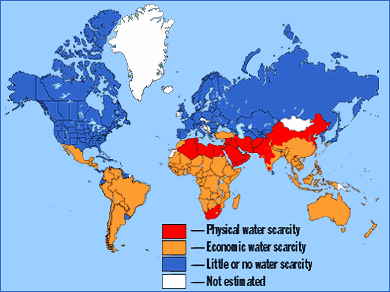
Making news stories this week is a report conducted by World Bank programs on "Addressing China's Water Scarcity..." From the abstract:
This report reviews China's water scarcity situation, assesses the policy and institutional requirements for addressing it, and recommends key areas for strengthening and reform. It is a synthesis of the main findings and recommendations from analytical work and case studies prepared under the World Bank Analytical and Advisory Assistance (AAA) program entitled 'addressing China's water scarcity: from analysis to action.'
Labels: global security
January 05, 2009
2009 PREDICTION: CHINA WILL NOT CRASH

A theme is emerging among US journalists prone to project America's problems elsewhere that the big story of 2009 will be massive "social unrest" or "instability" in China that will lead to a Tiananmen Square type crackdown.
The meme ranges from trite to thoughtful and will most likely be a common refrain in the first part of the year. But Sinomania! can predict confidently that China will not fall and there will be no cataclysmic showdown between Beijing and the Chinese allegedly (so the MSM tells us each day) "yearning" for American style democracy.
Yes, China's economic slowdown is scary. But consider the contrast from conditions in 1989:
Inflation is the big bugaboo in Chinese politics as in any political system. Remember it was rampant hyperinflation that ended the Chiang Kai-Shek regime on the mainland. In 1989 the inflation rate was running at double digits (21% at the end of 1988) and rationing of some consumer staples had just ended in big Chinese cities. The 2009 CPI forecast is -0.8%. That's right, DEflation is the issue although most analysts believe that it is deflation due to supply shock not a collapse of the monetary system. And deflation is expected to persist perhaps all the way to 2010.
But what about GDP growth slowing all the way (!) to below the magic number of 8% - surely once that happens all hell will break loose since Beijing has no experience dealing with a major recession? Actually, the impression is wrong. It is not true that Beijing has never dealt with a major recession. On the contrary, the recession of 1960-61 was marked by a drop in GDP of -27.3% equivalent to the worst years (1931-32) of the Great Depression in the USA and recession occurred again in 1962 (-5.7%), during the Cultural Revolution (1967-68 -4.1%) and the year Mao died (1976 -1.6%). In 1989 GDP growth was just over 4% and fell to 3.8% in 1990. And during the so-called Asian flu in the late 90's China GDP growth fell below 8% (7.8% in 1997, 7.1% in '99).
Consider the differences in Beijing's financial position today:
Chinese banks have $6.85 trillion in deposits including around $2 trillion in foreign exchange reserves held chiefly in US dollar bills. By contrast in 1989 Chinese households had only 515 billion yuan deposited at the bank (approximately $138 billion US at the time) and a mere $5.5 billion in forex reserves.
Every economic indicator fell dramatically in 1989 including capital investment which is set to rise significantly in 2009 when Beijing's giant infrastucture stimulus programs are underway.
And signs are that China's economy may already be rounding the bend.
The pace of decline in industrial output slowed in December - that is output and new orders improved last month. The WSJ is reporting that China’s bond market is recovering and up to $235 billion in Chinese bonds are expected this year even though 1 year yields may dip below 1%.
The economy will be a big story all over the world this year but journalists and publishers hoping to focus instead on sexier and easier lines about an [insert color here] revolution in China will be disappointed.
(c) 2009 Ben Calmes, Sinomania!
Labels: global economy, global security
December 31, 2008
Hamas Using Chinese Missiles?

So says Israeli General Benr-David according to an Internet source. The allegation is that Chinese rockets developed but not put into production by Sichuan Aerospace have somehow fallen into the hands of Hamas insurgents in the Gaza Strip...
Labels: global security, military-industrial complex, missiles
December 18, 2008
Gunboat Diplomacy: Enter China

The admission by Beijing's Foreign Ministry that it was seriously considering sending warships of the People's Liberation Army Navy (China's navy) to the Gulf of Aden has certain quarters of the Internet abuzz. Officially the US Navy Command in the Indian Ocean (based in Bahrain) welcomes the help of the Chinese navy to fend off the pirates operating off the long (over 1,800 miles) coastline of Somalia.
A new UN Security Council resolution authorizes cooperation by nations in responding to pirate attacks.
Earlier this month a Chinese cargo vessel, the Zhenghua 4, was attacked by pirates. Approximately 5 Chinese ships enter the Gulf of Aden each day and that number will increase once new port operations at Piraeus, Greece, are complete.
Labels: chinese trade, free trade, global security, navy
December 15, 2008
Taiwan Reunification Watch - Now Direct Daily Flights

Beijing and Taipei today announced new direct daily flights, shipping routes, and postal links as the 60 year old tension in the Taiwan Straits subsides (source: Reuters).
This situation is similar to Hong Kong after the handover agreement in 1984 when trade ties were growing strongly but exploded shortly afterwards. For example, the China-Hong Kong reexport trade grew from $7 billion (US dollars) in '83 to near $24 billion by just 1987. Today China is Hong Kong's leading supplier and export market.
According to the Reuters link above the value of China-Taiwan trade in 2007 was $90 billion. We can expect this number to swell significantly in the years ahead. Taiwan manufacturers have been relocating production to the mainland for years now and this process will only accelerate with direct links. What we are witnessing is the peaceful process of economic absorption. When (or if) there is ever a political reconciliation between the two rival political parties of the Chinese Republic, it will be an anti-climax just as it was in Hong Kong in 1997.
Seen in the context of the China-Korea-Japan summit this past weekend, it appears that East Asia is coalescing around China.
This situation is similar to Hong Kong after the handover agreement in 1984 when trade ties were growing strongly but exploded shortly afterwards. For example, the China-Hong Kong reexport trade grew from $7 billion (US dollars) in '83 to near $24 billion by just 1987. Today China is Hong Kong's leading supplier and export market.
According to the Reuters link above the value of China-Taiwan trade in 2007 was $90 billion. We can expect this number to swell significantly in the years ahead. Taiwan manufacturers have been relocating production to the mainland for years now and this process will only accelerate with direct links. What we are witnessing is the peaceful process of economic absorption. When (or if) there is ever a political reconciliation between the two rival political parties of the Chinese Republic, it will be an anti-climax just as it was in Hong Kong in 1997.
Seen in the context of the China-Korea-Japan summit this past weekend, it appears that East Asia is coalescing around China.
Labels: global security, ma ying-jeou, reunification, taiwan
December 12, 2008
China-Korea-Japan Summit Opens

An important first step for a self-directed regional integration of northeast Asia began today in the Fukuoka, Japan, with a summit between China, (South) Korea, and Japan.
Topics on the agenda include stabilizing banks, joint oil and gas exploration, and security issues.
Labels: asian energy security grid, global security, panic of 2008
November 20, 2008
Fish and Chips

The US-China Economic and Security Review Commission (set up in 2000 as a consolation prize to anti-China Trade Relations Act foes) has released its annual blather accusing China of manipulating its currency and of dangerous outer and cyber space data stealing and exports of fish.
Wortzel's Last Blast of Hot Air
Five of the 12 commissioners will end their 2 year terms on December 31, including Chairman Larry Wortzel, the Heritage Foundation's China "authority" who was given the chairmanship by disgraced former House Speaker Dennis Hastert (R-IL).
With the current crisis surrounding the Panic of '08 and China's status as the USA's number 1 creditor, it would be wise for the incoming Congress to appoint less biased members to the panel.
With the current crisis surrounding the Panic of '08 and China's status as the USA's number 1 creditor, it would be wise for the incoming Congress to appoint less biased members to the panel.
Labels: china policy, global security, panic of 2008
November 14, 2008
China Could Join War in Afghanistan

According to a Pakistan source, British PM Gordon Brown told a Council on Foreign Relations gathering that he believed Chinese troops could join the coalition fighting the Taliban in Afghanistan. Lest if be forgotten, China founded the Shanghai Cooperation Organization in 1996 specifically to counter terrorism from Afghanistan.
Labels: global security, war
November 12, 2008
Pakistan Instability Containing China?

The USA and India are behind the recent severe instability in Pakistan in order to "contain" China according to an opinion piece in the Pakistani paper The Post.
Labels: global security, great power, india
May 08, 2008
China, Japan Announce "Common Strategic Interests"

The first state visit by a Chinese President in a decade has led to a joint agreeement for "Consolidating Exchange and Cooperation Between Japan and China" including a possible end to disputes over the gas and oil riches under the East China Sea. Discussions between Hu Jintao and Japanese Prime Minister Yasuo Fukuda today reveal the two sides may agree to jointly develop the gas and oil of Shirikaba gas field and other disupted areas.
Labels: china, fukuda, global security, hu jintao, japan, oil

Subscribe to Posts [Atom]
