September 21, 2009
China Watchers Can't See the Tea for the Leaves

The 4th plenary session of the 17th Chinese Communist Party Central Committee ended in Beijing last Friday. According to China watchers and so-called "experts" the party meeting was a bust primarily because their prediction that party secretariat (and current Vice President) Xi Jinping would be promoted to China's Central Military Commission fell flat.
Mainstream media China commenters and analysts along with most of the traditional "gatekeepers" of China disinformation believe Xi Jinping will be the next president of China because he is supposedly aligned with Jiang Zemin. What is lost in this interpretation is the sea change that occurred in the first ever peaceful transfer of power in 2003 when Jiang Zemin stepped down and in the last party congress that selected the current leadership. Hu Jintao's power does not derive from alliance with a former great leader a la Mao or Deng but from his political base the Communist Youth League. Also from the Communist Youth League is Vice Premier Li Keqiang.
According to mainstream China watchers Li will be Wen Jiabao's replacement as PM in a new administration. But this writer believes Li has every chance of becoming China's next president. Here's why: the Chinese Communist Party is changing rapidly. Membership is growing fast and members are getting younger. Over 70% of delegates to the last party congress were under 55 with several hundred under 45. These party members were only teenagers or even younger when Chairman Mao died. They are not committed to "follow the leader" political successions.
And the party is now openly discussing the expansion of what it terms "intra-party democracy" with plans to engage non-party affiliated figures such as Health Minister Chen Zhu and the historic Chinese People's Political Consultative Conference. This news has great potential ramifications including the elusive possibility of multi party political participation. Yet it is completely ignored by western news reports. Fact is there is a lot of change going on in Chinese politics. But you need to step away from the silk screen to see it.
Labels: democracy, elections, hu jintao, reform

August 31, 2009
Japan Ends One Party Rule - DPJ to Focus on China Ties
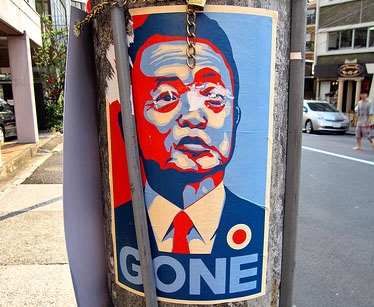
The landslide victory of the Democratic Party of Japan (DPJ) over the Liberal Democratic Party (LDP) cannot be overlooked. One party rule has ended in Japan. The LDP has run Japan since 1955 not long after the USA ended its occupation. The DPJ has a long history of relations with China. The man most likely to be the new Japanese Prime Minister, Yukio Hatoyama, said on the campaign trail he would not honor Japan's World War II dead (considered war criminals by many Asian nations) at the Yasukuni Shrine, long a point of contention with Beijing. And Hatoyama has said he wants to emphasize Sino-Japan ties and views the future as a multi-polar world. Are the days of the reliable Japanese satellite waning for the USA....?
Labels: democracy, foreign relations, japan
March 06, 2008
National People's Congress Open For Business

The first session of the 11th National People’s Congress convened Wednesday (March 5, 2008) at the Great Hall of the People in Beijing.
Premier or Prime Minister Wen Jiabao opened the session with remarks on the state of the Chinese union emphasizing challenges ahead particularly dealing with inflation.
Beijing will pursue a “tight monetary policy” according to Wen signaling the central government’s worry over excessive liquidity and runaway growth in some areas.
As expected, Beijing will channel excess cash into more state investment, already accounting for over 45% of China’s Gross Domestic Product. Investment targets will be health care and social security bureaucracies based on United States models. Housing and safe drinking water for China’s impoverished classes will also receive state directed investment.
The Congress will vote on the candidates already selected last October by the Communist Party for top government positions. Hu Jintao will no doubt be elected for a second and final 5 year term as President.
But there are some interesting items to watch on the Congress agenda. For example, debate on “institutional restructuring of the State Council,” China’s day-to-day working government and a vote on changing the election law to adjust the level of representation for rural Chinese.
Currently, each rural delegate of the Chinese congress represents 4 rural residents. The aim of the reform is to increase representation for Chinese rural citizens. Also there will be discussion of a Congressional delegation for migrant workers.
And in another show of support to the vast floating population of migrant workers in China, by some estimates perhaps 200 million people, Wen Jiabao announced mandated paid vacations for migrants.
It is easy for foreign observers, particularly American media, to dismiss the National Peoples’ Congress as a rubber stamp farce. But as I’ve pointed out before, you ignore the work of the NPC at your peril.
The Congress affirms the direction China is going and gives law to Beijing’s policies. Each year thousands of petitions, white papers, and forums are presented by ordinary Chinese (an ancient tradition, by the way, that predates any Chinese republic) and in this great airing of gripes and views are clues to the aspirations and desires of the Chinese people.
The NPC will adjourn March 19. I’ll have a report on this year’s session in next week's episode of The Sinomania! Show video broadcast.
Labels: china, democracy, government, migrants, national peoples congress, reform

Subscribe to Posts [Atom]
