September 22, 2010
China Has No Property Tax
The rumour mill is running full speed in China with the latest report by a Chinese newspaper called China Business News that Beijing will implement a property tax at the beginning of 2011 according to a highly-placed anonymous mandarin. Currently China has no property tax a fact that might startle many Americans who continue to view China as as a heavy handed "communist" country. Where the property boom is hottest in cities such as Shanghai and Chongqing property tax proposals have been put forth and some trials are in place. To date however there is no official word on any property tax. Beijing continues to dampen property prices with restrictions on second and third homes and onerous down payment requirements....
Labels: china property, private property

January 29, 2010
China Housing Not A Bubble

Calls for China’s crash usually happen at the start of the year and 2010 is no exception. This year’s blame China crowd includes the usual editorial boards (Financial Times, Wall Street Journal), a Nobel prize winner (Paul Krugman) and more usual suspects such as Gordon Chang (is a near 10 year old prediction still relevant?). Hedge fund manager Jim Chanos made a big splash warning to stay away from China because he said Beijing’s stimulus created a housing and property bubble. Chanos has since backed away somewhat from his comments but warnings of a China property bubble persist including from the World Bank.
The predictions however do not take into account that the indicators of a housing and property bubble as burst in the USA and EU are not the case in China. Chief among the differences is building construction in relation to demand. The housing bubble and commercial real estate bubbles in the USA and EU were not driven by demand. In the USA whole suburbs of empty houses and strip malls stand vacant. In some areas such as Victorville, California, neighborhoods are torn down and plowed under. In cities across America and Europe holes and vacant lots mark the spots of cancelled buildings.
Yes China is in a building boom. Property sales rose 75% last year alone. In 2007 China accounted for half of all new building areas on the planet. How is this not a bubble? Consider the transformation of Chinese society from rural to urban. The housing stock in China remains woefully inadequate. In the USA nearly a fifth of the housing stock was built before 1940. But China’s housing stock was devastated by continuous war until mid century and deteriorated further in the 1950s as private households neglected properties fearing state confiscation and housing was lost to industrial development. Any traveler visiting outside China’s cities can attest to the poor state of rural housing. All the new migrants to Chinese cities will need housing. And current city dwellers want better housing.
A similar comparison exists for commercial real estate. Half the commercial buildings in America were built prior to 1970. China’s building boom began with commercial buildings in the 1980s and ‘90s but still has a long way to go. Typical indicators for commercial property viability such as vacancy rates do not fit the Chinese market. It is not at all unusual to see 50% or greater vacancies at the peak of office space building cycles for example.
The primary category of residential building in China is multi-family low and high-rise. Add to that the demands for high-rise commercial buildings for offices and hotels. The materials required for such construction create huge demand for everything from steel and concrete to carpet and computers. Yet as a percentage of GDP the building construction industry in China (around 5-6%) is not much greater than in the USA (4.6%-4.1% between 2004-07).
Beijing is responding to world opinion and investor concerns. New policies introduced recently include 20% down payment requirement on property and 50% on land. But as to rumours that China will implement a property tax (currently there is none) the State Administration of Taxation said this week it was only in the “research and preparations” stage. Potential speculation in property on tropical island province Hainan alarmed the Financial Times but the report failed to mention that the governor of Hainan has suspended new land leases and development plans.
Property remains a barometer and important component of China’s economy. And many analysts continue to find property stocks attractive. The Changjia Group will IPO on Hong Kong in March and Sun Hung Kai properties is a media and investor darling. Foreign investment continues in the commercial sector too. Starwood Hotels says it will double its portfolio in China over the next two years to over 100 hotel properties.
Labels: china property, foreign investment, private property
December 07, 2009
Free to Shop

Beijing will loosen the infamous hukou system in a bid to hasten urbanization and get Chinese to consume more. The Central Economic Work Conference of China's central government met over the weekend and announced reforms of the hukou or household registration system to allow rural migrants to gain citizen's rights (access to eduction & housing mostly) in small to medium sized cities. The expansion of hukou rights may allow many migrants to settle in the cities where they find work.
The Work Conference embraced the concept, mostly imposed on China by Western partners, that consumption must be a driving (if not the driving) force in the Chinese economy. The conference said the goal was for consumption to replace public spending. Yet a more rapid settlement of migrants to China's growing mega cities will only increase the need for more infrastructure - roads, railroads, subways, housing, electricity, etc., which is reflected in the dominance of investment as a major force in China's economy. Stocks in property companies rose today, some analysts say on the news. But rural migrants are at the bottom of the elaborate class structure in China and usually too poor and too conservative to quickly become materialistic consumers.
The hukou system began in the early 1950s as a way to prevent Chinese cities from becoming overrun by poor rural migrants and end up like the major cities of the so-called developing world, that is overwhelmed by slums and unplanned development. The system became a major component of the centrally planned economy at the height of Mao's dictatorship and ultimately held back China's cities. Since 2001 it has been relaxed to varying degrees at the Provincial level and in national policy. Also as with so many laws in China it is often completely ignored....
Labels: china property, land reform
July 01, 2009
Kashgar's Wrecking Ball
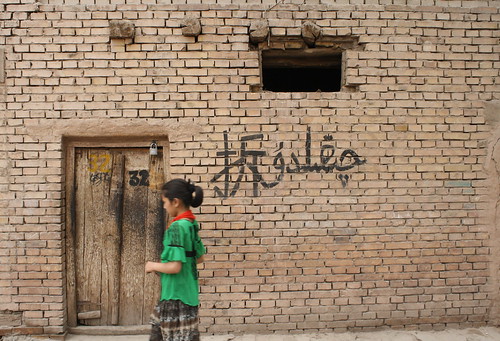
Kashgar in far western Xinjiang Autonomous Region may well become the most important logistics hub in western China someday. Work is already underway to at some point in the medium to long term connect the city with the Gwadar port in Pakistan. It is a city of the future and an important area to watch as China acts out its version of 19th Century America's 'manifest destiny'.
As they say in China you have to tear down the old to build the new often with good results all 'round. But sometimes the very essence of a place is lost in the process. This writer was saddened by the crass demolition and rebuild of the ancient shopping area south of Qian Men gate in Beijing. An interesting, if dilapidated, collection of buildings and narrow alleys was replaced with a garish Hong Kong meets Hollywood fakery that destroyed all its original charm.
Kashgar is busy redeveloping its old city - a huge tangle of old buildings and alleys built around extended family homes connected to shops and businesses organized around central courtyards, an urban form as old as Eurasia itself - into modern highrise blocks with plumbing and electricity for all. Beijing wants no repeat of last year's Sichuan earthquake catastrophe with its collapsed buildings and massive fatalities. An added feature -- whereas before you had to meander a block to find a certain shop, the new developments will feature streetside shops and markets....
Labels: china property, earthquake
December 23, 2008
China Bank Rates Cut Again

The People's Bank of China cut interest rates 0.27% today but the expected move was not enough to excite equity markets in Shanghai (the Shanghai Composite Index is back down below 2,000) or Hong Kong.
In related news, Beijing is committed to do more to shore up the property market - believed to be the key sector of China's economy right now and critical to avoiding a hard landing of the Chinese economy is a robust property market. Beijing will fund a massive house building campaign - 1.3 million homes for low-income families - similar in concept to Uncle Sam's house building program in the late 1940s. (Source: Bloomberg)
Labels: banking, china property, panic of 2008
November 30, 2008
Hu Says Faster Reform Needed

In Beijing the Political Bureau of the Communist Party of China (CPC) Central Committee met this weekend and President Hu Jintao made a headline statement about China losing its economic competitiveness if it doesn't continue to evolve. The meeting has particular significance since it falls on the 30th anniversary of the start of Deng Xiaoping's "opening up" reform movement of 1978. The era since that time was nicely encapsulated by the Swedish Ambassador to China in a talk in Stockholm today.
Hu's words and other official and quasi-official statements about the need to hasten change in China's domestic policies seem to point to full implementation of the land reform promised at October's party meeting. This is a trend worth watching...
Labels: china property, hu jintao, land reform, panic of 2008
November 13, 2008
China Commercial Property Stays Strong

China remains a bright spot in the otherwise glum commercial property sector according to the Royal Institute of Chartered Surveyors latest Global Commercial Property Survey.
Remember, the property sector as a whole is one of the key drivers of the Chinese economy.
Labels: china property, private property
September 04, 2008
PROPERTY Sector Key to China Economy?
 Morgan Stanley's China Analyst Qing Wang thinks so:
"We believe that the outlook for robust growth in China hinges critically on
the sustainability of investment growth in the property sector. Indeed, it is
hard to justify a positive outlook for the Chinese economy in the next 12-24
months, unless one remains constructive about the role of the property sector as
an engine of growth, particularly in some areas (e.g., Chongqing)."
Wang believes property is not a bubble in China, arguing that China's high house-price-to-income-ratio can be reduced and is not out of line with other so-called developing nations. There is risk however Beijing may restrict the property sector and cause a hard-landing to the economy.
China Property remains a sector to watch...
Labels: bubble, china property, chinese stocks, foreign investment

Subscribe to Posts [Atom]
